Tuesday, February 20, 2018

Protest songs and the power of music :

Music was always used as a form of power and it still is. In the 20th century, there was a period when music was particularly used as a form of power, it was in the 60's with the hippie rock movement. This movement started in the U.S when its younger population started to take a critical look at their country; the Vietnam war, segregation, mass consumption. Young people didn't want their country to be like that. Art and mainly music immediately started to be part of the movement with emblematic figures like the Beatles, Jimmy Hendrix and many more who sang what we call protest songs.

We are going to pick one of the most emblematic protest songs ever written, "Blowin' in the wind" by Bob Dylan.


How many roads must a man walk down
Before you call him a man?
How many seas must a white dove sail
Before she sleeps in the sand?
How many times must the cannon balls fly
Before they're forever banned?
The answer, my friend, is blowin' in the wind
The answer is blowin' in the wind
How many years can a mountain exist
Before it's washed to the sea?
How many years must some people exist
Before they're allowed to be free?
And how many times can a man turn his head
And pretend that he just doesn't see - the answer
The answer, my friend, is blowin' in the wind
The answer is blowin' in the wind


How many times can a man look up
Before he sees the sky?
How many ears must one person have
Before he can hear people cry?
And how many deaths will it take 'till he knows
That too many people have died?
The answer, my friends, is blowin' in the wind
The answer is blowin' in the wind
Oh, the answer, my friends, is blowin' in the wind
The answer is blowin' in the wind

 Bob Dylan was one of the most engaged singers from the 60's, he was not only a singer but also a poet, he indeed received the Nobel price for literature in 2016. "Blowin' in the wind" is a song from 1963 and grasps many subjects of the time but mostly the one of war.
Bob Dylan asks questions about war and other atrocities committed at the time, for example "how many ears must one person have before he can hear people cry", he wants to say that people don't see the atrocities lived and committed by the americans since two years in Vietnam, they don't hear "the cries". The first verse is about segregation "How many roads must a man walk down
Before you call him a man?", he surely talks about the civil rights marches that were done by the African-Americans to obtain their rights, to be called "man". In the chorus he says "the answer is blowing in the wind", he wants to say that the answers are just right in front of us, waiting for someone to grab them. 
 We can totally say this song is a form of power, we saw the power of death and the power of guns, well this song is a weapon itself. Bob Dylan uses his song lyrics to fight against guns and war. I don't think all these protest song didn't play a role at the time, young americans in Vietnam listened to this kind of music and it may have had an effect on their motivation to fight, and the consequence is that they lost war. Black people obtained their rights at that time and artists like Bob Dylan played a great role in that fight.
 I wanted to mention Joan Baez too, she was Bob Dylan's girlfriend for years and wrote many of his songs, I think myself that she was even more engaged then him, she participated to many humanitarian projects and she still acts for humanity today.





Sunday, February 4, 2018

Post 9: The US gun culture

Brady campaign to prevent gun violence

The Brady Campaign to Prevent Gun Violence and the Brady Center to Prevent Gun Violence are affiliated American nonprofit organizations that advocate fogun control and against gun violence. It was founded in 1974, and named Brady campaign after James Jim Brady was permanently disabled as a result of Ronal Reagan assassination attempt of 1981.
This document is a poster from the Brady Campaign to Prevent Gun Violence for a Campaign they're running since 44 years. This version is from 2010 and it raises the controversial issue of gun violence, mainly in the U.S.
What first stands out of the poster is the image of a gun. We immediately see the stars and strikes of the American flag as their colors are red and blue. At the top of the image of the gun is a short text. The text starts and finishes with bigger letters. The first line says "In one year, guns murdered..." and it is followed by the example of a few country and the number of deaths by gun for each of them (Spain, Germany...).The bigger letters at the end of the short text say "god bless america". We can finally see the logo of the Brady campaign in the bottom left-hand of the poster.
This poster is probably aimed at the American people but also to the American government. The idea of the the poster is to compare the U.S with other northern countries such as Germany, Canada. These countries were taken on purpose and for a good reason; they're developed countries, and the poster indirectly asks the U.S to take them as a model. For example, Canada was chose certainly because it's a very close country to the U.S, not only geographically but also culturally and guns are illegal there, so the U.S don't need guns either.
"God bless america" is surely said ironically. It's an expression often said by American nationalists, precisely people who buy these guns and who claim that these gun laws don't affect on gun deaths and that on the contrary they serve for legitimate defense. But Americans wouldn't need to defend themselves if guns were illegal in the first place.
I find this cartoon very efficient and striking, it is well thought to compare the U.S with other developed countries, it uses americans' pride to reach the american people. It also uses irony, it is a good way to make fun of some people, also to make them feel guilty. 


Gun murder graph

This 2010 graph is from the UNODC. It is in fact composed of two column bar graphs.
First graph is the number of people that died of gun murder between the years 2004 and 2010, rated per 100 000 people. They classified the top 10 countries plus the United States from the most murderous one to the less. The first place is for Honduras with more or less 68 deaths, the last one (in the top 10) is for Brazil with 18 deaths. The US (which isn't in the top 10) is in the 26th place with more or less 4 deaths.
Second graph is the same graph but the countries of the top ten are from the most developed one to the less, according to their Human Development Index (HDI: composite statistic (composite index) of life expectancyeducation, and per capita income indicators, used to rank countries into four tiers of human development). The most murderous developed country (not counting the US) is Switzerland with 0.8 deaths. The less murderous one is Japan with NO deaths! If we count the united states, it easily takes the first place with 3,2 deaths. 
These two graphs are in fact focused on the United states, they wan't us to compare the US with the other countries. The first graph basically says that in this rank, the US is put with less developed countries such Jamaica, Colombia and that the number of people murdered by a gun isn't very different from these countries. The second graph wants to compare the US with, this time, other developed country but unfortunately, the US is the most murderous countries of them all.

Two cartoons

Gun lobby and congress is a 2010 ten cartoon from startribune.com and drawn by Steve Sack. We can see the American congress (American flag), and two well-dressed people talking. One has a suitcase with written "congress" on it and the second one with "gun lobby" on it. The gun lobby guy gives a bag of money to the congress guy and says "now where were we before we were so rudely interrupted".
This cartoon wants of course two say that there is a lot of corruption in the US politics and that the gun lobby pays the congress for it not let laws on gun illegality pass. The blood on the stairs of the congress seems to come from the congress guy, which would mean he is indirectly a murderer, like the gun lobby guy.

Second amendment and NRA is 2013 cartoon from davegrandlud.com and drawn by the cartoonist Dave Grandlud. We can see two characters, an old statue of a revolutionary man and a soldier with lots of weapons standing on boxes of AMMO. This cartoon critisize the fact that the NRA link the American revolution with violence and weapon. They think heroes are people with weapons because founding fathers of the US did the revolution with violence but it was'nt the same type of violence, they were obliged to use it and they used it for peace and unity.


Thursday, November 23, 2017

Tim Burton


Fill in the gaps in this biography of Tim Burton


Tim Burton was ___born_____in 1958, in the city of Burbank, __California__________.
He remains without question one of the __most______ original film director_________ working in ____Hollywood________ today.


Indeed, his talent and originality have kept him at the ________ of the profession where he occupies a very special place, somewhere ___________ the mainstream and the avant-garde, in that region of cinema occupied by artists ______ worldview is _______ unconventional that it attains popular appeal.


In 1989, Tim Burton directed the hugely _____popular_____ Batman which, although his _______ personal film, was one of the most _____seen_______ movies of all time and gave him unprecedented _____fame______ in Hollywood, considering the originality and adventurousness of his ____________ films (for _________ Beetlejuice in 1988).


Edward Scissorhands (1990), another hit, saw him at the peak of his ___artistic_____ powers and established a fruitful working _____________ with ___________ Johnny Depp who played in his 2005 film _____charlie and the chocolate factory________of Roald Dahl’s book Charlie and the Chocolate Factory and who became one of his most esteemed ___actors_______since their first film together.


In 1992, Batman Returns was a __much_____ darker film than the original, a reflection of how much ____________ freedom Tim Burton had won (_______ Warner Bros were reputedly unhappy with the final result).
And even _________ Ed Wood (1994), his loving ___________ to the life and work of the legendary ‘Worst Director of All Time’ Edward D. Wood, Jr., was a box-office disaster, it got some of the best _____films_______ of Burton’s career.


In fact, Tim Burton is __famous____  both for his dark, quirky-themed ____movies_______like Sleepy Hollow, Corpse Bride, Sweeney Todd: The Demon Barber of Fleet Street, or Dark Shadows (2012) and for ____________  such as Pee-Wee's Big Adventure, Batman, Planet of the Apes, Charlie and the Chocolate Factory and Alice in Wonderland (2010), one of his most  ____famous____ films, which became the fifth highest-grossing film of all ___times____.


Burton has ____received_______ 18 feature films as of 2014, and has _________ 12 as of 2012  (among which the very nice ______-______ tale called The  Nightmare Before _______________ in 1993).


All in all, Tim Burton’s films consistently challenge the spectator’s ___________, push forward the ____________ of filmmaking and bring to life previously unthinkable ____________ (like Edward Scissorhands).


Taken as a whole, his work ____________ on the confrontation ____________ the fantastic and the _____________, and the consequences of these two worlds intermingling.


Big Fish, Burton’s 2003 effort, is no different. And ______, somehow, it is not really the _________.
On the surface, it would appear to have all the ___________ of a classic Burton film: a magic screenplay, fairy-tale characters, flights of imagination, forces of nature ( _____ well _______ the supernatural), far-fetched situations and vastly imaginative visual style and imagery. The movie is, in fact, ________ packed with fanciful episodes that it begins to feel ___________ a loose adaptation of The Odyssey, told from the mouth of an aging character named Ed Bloom, a story-__________ and dreamer who sees the world with beautiful eyes.

Wednesday, November 15, 2017

An art exhibtion review

"Pop art myths" was an exhibition from 2014. It was exhibited in the "Museo Thyssen-Bornemisza", in madrid, from June 10 to Septembre 14 of 2014.

Résultat de recherche d'images pour "pop art myths"

The artists involved belonged to the Pop art movement wich emerged in the late 50's and early 60's. An iconic artist of the movement was the famous Andy Warhol who started the movement with a few other artists like Richard Hamilton and Eduardo Paolozzi. The exhibition was on for 3 months in a museum in madrid. It is the curator of the museum who was involved in the creative process.

I found the exhibtion well done because it doesn't only show us what we already know about pop art like portraits of Marilyn Monroe or beans cans but it shows us pop art that the public doesn't know. I really liked the work with the word "EAT" composed of light bulbs. As I really saw the exhibtion, I can say that this work is much worth it in real as it composed of bulbs and in a virtual visit the light is less striking. I don't know why this work stayed in my memory, but we can surely say it is pop art as it suggests the american way of life with the bulbs that makes us think of the typicall miror in wich actors look at themselves before playing their role in Hollywood and the word "EAT" in capital letters that can suggest the exagerated production and consumption of food in the U.S.. I could criticize the fact that in the virtual visit we can't see the titles of the works, their artists, their date and it's a pitty because it is important to know the context and the credits. I chose the painting "Retroactive II" from Robert Schaunenberg as it is one of the works that I still remember and I think the artist's message is shared in a very subtle way.

Résultat de recherche d'images pour "retroactive II"
Retroactive II, Robert Schaunenberg, 1964, 213x152cm

This image is a collage from the year 1964, it has a pretty big size. The painting is composed of many layers; photos, paint, paper. What strikes at first sight is the familiar sepia tone photo of J.F Kennedy, who's pointing more or less in our direction. Next to it is another photo of a spaceman, the colors are contrasting as this one has more of a blue and cold tone. We can kind of see a vehicle at the top of the painting and a part of an old painting, also in the same tone as the spaceman, certainly from the renaissance. At the bottom of it we can assume there's a box filled with fruits, maybe apples. The painting is also composed of a lot of unclear pictures, like if the artist wanted us to doubt about what we can see.
The artist represented two American idols, J.F Kennedy and the spaceman which can also be assimilated to myths, that they may become in the future. But the painter didn't want to praise these characters but to criticize all the events of the period, we could think of the war in Vietnam if we make a link between the vehicle (it seems to be a war vehicle) and the president. With the spaceman we could also think of the Cold War and the race of space conquest between americans and soviets
I think this painting is very subtle as we could think at first sight that the painter is praising these American Idols but he is in fact criticizing them. The painting seems disordered and messy and I think the artist wanted to link it to the state of his country at the time, U.S. wasn't in a stable situation, a lot was happening with the U.S. and the rest of the world.
I thought the exhibition was also well done, I think it is important to see pop art exhibitions nowadays because I think it is present everywhere in art, a lot of artists nowadays are in fact descendants of pop art movement. We can now some street artists that mix pop art and street art that emerged at the same moment.

Résultat de recherche d'images pour "pop art street art"

Sunday, October 8, 2017

Progress of music in the world

Music has always been among us, but since the 20th century, there's been a huge progress in many aspects.

1. Consumption

First, we changed the away of consuming it, there was the vinyl then the CD and today we listen to musique on our phones. The problem with listening to music on the internet is that we can get all the music we want for free and artists don't sell their album on a CD as they use to.
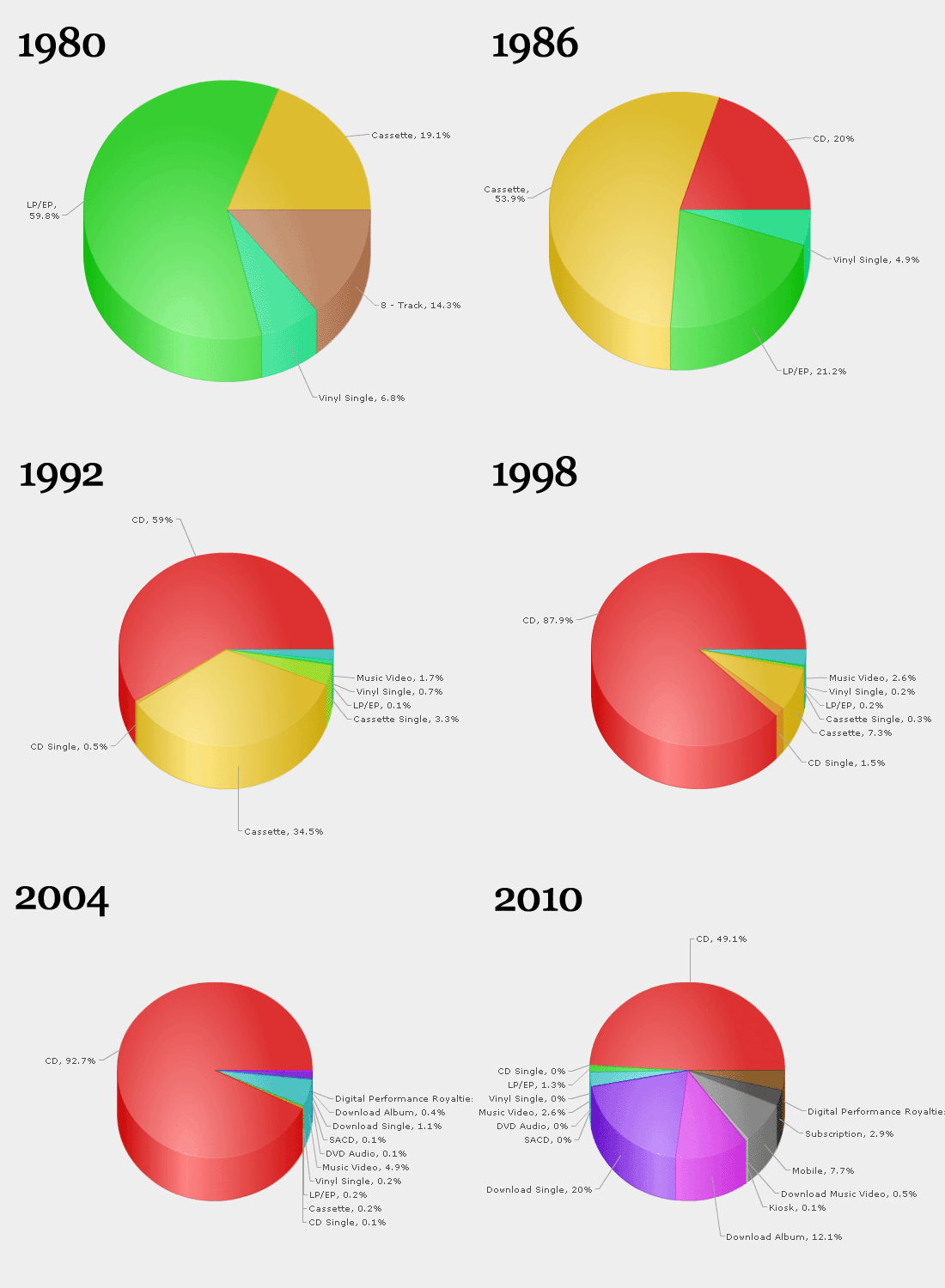
Here is an animation that was published by Kevin Short in the Huffigton post's website. It illustrates the evolution of music consumption, as it is very complicated because there's been many ways to consume music, we'll focus on the CD and internet downloading parts.

  Since the CD appeared in 1983, it didn't stop growing and more and more people started to consume music with CDs. It is in 2002 that it reached its climax, 94% of music was consumed on CDs. 2002 is also the year were the CD started to drop, because it is the year internet downloading appeared even though it took only 2% of music consumption at the time. But downloading grew faster and faster because it can be consumed on a computer, a phone, a tablet or an Ipod. In 2010 downloading takes more or less 45% of music consumption, CD takes 49%. Today, consumption on electronic devices is for sure bigger than consumption on CD. My point is that CD was something material that people would buy, and this is what would make money for the music industry but as today music is more and more consumed freely on the internet, it is a problem for the quantity of money that the music industry makes. We can't say that music dropped in quantity because we have to precise what; if we're talking of music consumption itself, the quantity of people listening to music is always growing as it is more and more accessible. But if we talk about money, the quantity of wealth created is dropping.

2. Music quality

What is High-Resolution Audio?

High-Resolution Audio is audio that uses a higher sampling rate than in CDs and MP3s for the encoding and playback of music. Higher sampling rates mean that more samples per second were taken when the original analog sound was converted into digital.
High-Resolution Audio files have a sampling frequency of 96 kHz/24 bit, which is significantly higher than the 44.1 KHz/16 bit sampling frequency of CDs.
How does that translate to the listening experience?
Listening to High-Resolution Audio allows you to pick up on the subtle details and nuances that you would hear in a recording studio. So, if you’re waiting to get your hands on Adele’s newly released album, “25”, try listening to it in high resolution. It’ll sound like you pulled up a stool next to the British diva, allowing you to hear every note of her soulful, impressive range.
On the other hand, when you convert analog sound to digital formats like CDs and MP3s, that process can compromise the purity of the original signal. High-Resolution Audio brings your favorite songs to life by retaining more data during the analog-to-digital conversion process.
This document is from Sony's website. When CD appeared the sound was way better than on vinyl or cassette. The mp3 format reached the same sound quality as CD. Everybody thought that we wouldn't have a better quality than these two format but then appeared high resolution audio wich is the equivalent of HD on your TV. We can mesure sound quality with sampling frequency, High res has a 96 kHz/24 bit sampling frequency while CD has a 44 kHz/16 bit wich is significantly a lower sound quality. High resolution enables us to hear little details of music that we can't hear with CDs or mp3, it allows us to listen exactly what the artist recorded in the studio and we can say this is some huge progress. What bettered the sound is also progress of recording material, micro for sure have a better quality then before.

To conclude, music did huge progress, it evolved in many genres, the quality of the sound is way better today than before and more and more people have access to it. But downloading is a problem to music industry. Will it always be a problem ? or could music industry find a way to make money on these downloading ?

Sources: - https://www.huffingtonpost.com/2014/08/22/music-industry-shift-gif_n_5697945.html
- https://www.sony.com/electronics/hi-res-audio-mp3-cd-sound-quality-comparison

Tuesday, September 19, 2017

The key issues behind chappatte's work

We figured out in class that there could be a few key issues behind chappatte's cartoon, here are three of them:
- Could the internet be a threat spread of culture or convorsely foster it ?
- Is the younger generation really aware of the illegal practices on the internet when it comes to culture
- Does the internet epitomize the idea of progress or can we argue that it also shows its limits.

We can truly say that Chappatte is an excellent cartoonist as he showed all these issues with only one cartoon, and 9 words. Chappatte used humor and irony through the young man, irony is the best weapon as everybody understands it although it doesn't say things directly. He also used the Cannes festival event as everyone knows the festival and it can touch every reader/viewer.

Wednesday, September 13, 2017

A fanatic geek at the cannes film festival, 2008

Résultat de recherche d'images pour "patrick chappatte"

Patrick Chappatte is a lebanese-swiss cartoonist who was born in pakistan in 1967. Born to a lebanese mother and a swiss father he lives between LA and Geneva. Patrick Chappatte draws cartoons for the international New York Time, the New York Time, le Temps,  Neue Zürcher Zeitung.
Chappatte is a rewarded cartoonist as he recived the Overseas Press Club of America’s Thomas Nast Award for best cartoons on international affairs. 
He currently participates to a project that has the goal of promoting dialogue through cartoons in conflict-ridden countries such as Serbia, Ivory Coast, Kenya and a few other. He presented his project in a TED talk in 2010.


This image is a cartoon by Patrick Chappatte, it was published in the international Herald tribune the 16th of may 2008. We can notice cannes' logo at the bottom of the cartoon, la "palme d'or" with cannes in capital letters at the bottom of it. Cannes is the most popular and important film festival in the world, it takes place in France and the rewarded artists receive the popular "palme d'or". The cartoon will certainly deal with this popular french festival.

What directly flash out of the drawing are the warm colors, the red carpet, the yellow cannes logo (the eye is automatically attracted by a logo), and the yellow dress/blond hair of a woman in the foreground. At the background of the cartoon, we can see a couple dressed in fancy clothes, walking up the stairs of the red carpet, waving at a huge crowd full of journalists taking pictures and fans asking for autographs. We can assume it is a famous couple, someone who participates at the festival. But the essential part of the cartoon is at  the foreground, another famous couple right at the middle of the image with a man (certainly a celebrity like an actor, a director...) signing an autograph for a young man, who wears a t-shirt with an "@" on it. The young is the only one talking in the cartoon and he says to the famous man "I love your movies, I pirated them all".
Chappatte used humor through this young man to denounce illegal downloading of movies on the internet. Chappatte wanted to tell us how ambiguous it is because the young claims he loves the movies of this celebrity but he doesn't make the film industry work as he illegally downloaded them. We can notice the director/actor is making a funny face as the teenager totally assumes he illegally downloaded this man's movie, the cartoonist uses comic of situation.
 I don't think money is really the problem with this issue as the movie industry is making a huge amount of money. But, if everybody starts to watch their movies illegally and most of all free, it may be a problem (and also for small budget movies).
I think this young man represents the whole of our generation, a generation that uses the internet for lots of things and even for illegal actions.
However these last years we saw the emergence of something new that I find really clever; Netflix. Netflix is an internet platforms with lots of movie and series, it is not free but very affordable. I think it is good for the film industry as you don't have to move from home to watch a movie and that it still costs some money and respects author's rights. Before I had it at home I use to watch my movies in streaming (illegally), since I have Netflix I no longer do this.